
Cultivating Your Relationship with Pain
The impetus for coming to PT is usually because of pain. Whether it is from a labral repair in the hip, achilles pain from hiking or running, low back pain from lifting at the gym, or whatever the situation may be, people find themselves having some type of pain and looking for answers and help. When people come through our doors, we often hear phrases along the lines of “I’ve been in pain for so long that my pain tolerance is crazy high.” And, the classic comment of “no pain, no gain.” And “I’ve heard PT is all about pushing through pain, so bring it on!” However, when I hear this, my response to this statement is usually, “That’s not necessarily true and let me tell you why.” In physical therapy, the most important relationship you can cultivate is the one between yourself and your pain.

Photo of a person leaning against the wall in frustration and contemplating next steps with regard to pain they experience.
According to the Center for Disease Control, 20% of Americans experience chronic, or persistent, pain, which is defined as pain exceeding 3 months. This not only impacts patients’ participation in daily activities but also their risk for comorbidities including depression, substance abuse, and dementia.
According to the Center for Disease Control, 20% of Americans experience chronic, or persistent, pain, which is defined as pain exceeding 3 months. This not only impacts patients’ participation in daily activities but also their risk for comorbidities including depression, substance abuse, and dementia. This means, people may not go out with friends downtown because it involves too much walking, work from home versus going into the office because driving causes pain. If you are reading this, is there something you are avoiding because of pain? And how does this make you feel?

Photo of a person working and rubbing their head possibly thinking about the pain they are in which can impact work and productivity.
But what is pain? Pain is an unpleasant sensory or emotional experience that results in actual or potential tissue damage or harm to the body. It is a sensation that your nerves detect and relay to the brain. This sensation is protective, allowing you to move away from the painful stimulus OR to seek help. When you experience pain, your brain has to determine “Am I in danger right now?” Your pain is very real because you are experiencing it, and because it has very real and tangible impacts on your daily life.
With that being said, most patients underestimate the agency they have over their experience of pain. When the acute injury or threat is no longer evident, it is STILL possible to experience pain. When this happens, it is important to understand our perspective of pain, what pain is, how it works and affects our body currently, AND how to shift this/our view of pain.

Photo of a person sitting down and thinking about the pain they are in.
Let’s talk about Dr. Lorimer Moseley, a clinical neuroscientist. He shared his experience with chronic pain. Dr. Moseley was an avid hiker, who became accustomed to the feeling of grass and twigs brushing up against his ankles and calves on hikes. One day, Dr. Moseley was bitten by a snake, and had an extensive and painful recovery process. When he was ready to return to hiking, he expected to feel the grass and twigs against his calves, but instead he experienced deep and excruciating pain. When he looked down, he saw the mundane sight of grass and twigs brushing up against his legs. After scanning the environment and remembering his recent experiences, his brain decided “Yes! I am in danger!” even though there was no actual evidence of danger at that exact moment. This is an example of persistent pain, when the body continues to feel pain despite no immediate threat being present any more.

Photo of a person’s lower legs walking on a log while on a hike.
Dr. Moseley’s story highlights some important points about pain. First, the experience of pain does not necessarily correlate or directly relate to the state of your tissues. There was no damage to his tissues on his hiking trip after the snake bite. Secondly, the experience of pain is deeply personal and is highly influenced by several psychological and social factors. Surely, Dr. Moseley’s snake bite, and the excruciating pain that came along with it, made him slightly worried about having another similar experience. The anxiety and previous experience triggered the amygdala, the part of the brain that creates fear, to become involved in the perception of his pain. Once the amygdala is triggered, this creates pain in the previously injured area. As you can see the experience of getting bit caused pain, however, even once the injury has healed, certain activities can trigger a response in the brain that can recreate the sensation of pain.
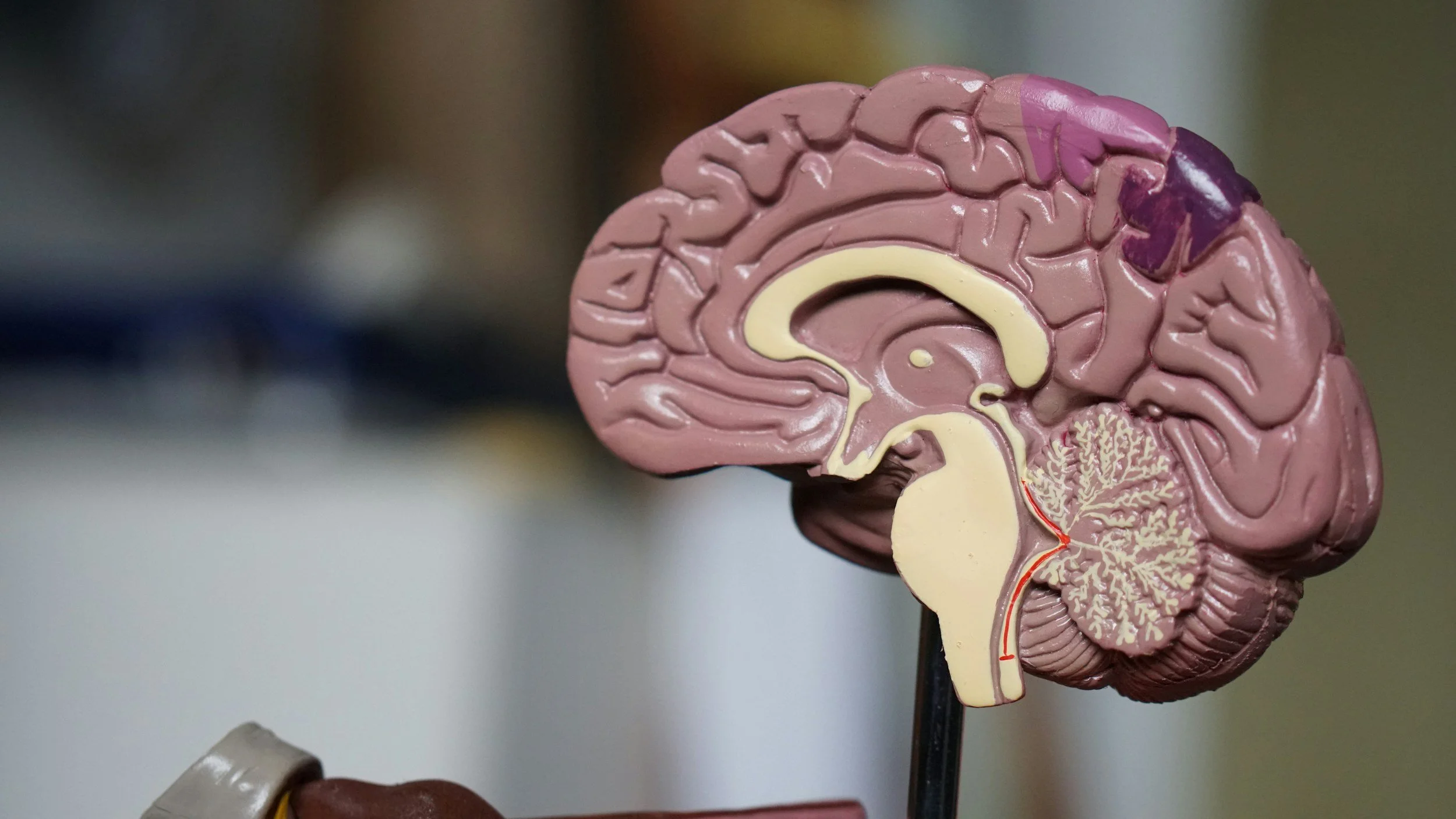
Photo of a cross section of a brain with the amygdala present.
With a firm understanding of pain and the factors involved in creating the experience of pain, it’s possible to change the experience of pain by shifting your perspective on it. One way you can do this is by altering the words you label your pain with, and just noticing the sensation instead. This doesn’t mean that you lie to yourself and erase your difficult and possibly debilitating experience. This means using neutral words to describe your pain instead. Some examples patients have shared with me include “spread out, deep, tight, warm, fluctuating, constant”. Using words that are neutral can help give signals to your amygdala that you are NOT in danger, and that your body is safe and thus reduce your pain.
Using a practice called “Somatic Tracking” can be helpful in shifting your experience of pain as well. Somatic tracking guides you to focus attention on the body part eliciting pain and focus on the sensation of pain. Next, it instructs you to notice the sensations without labeling them as strongly positive or negative sensations - just observing them. Research in chronic pain has shown that somatic tracking interventions can help to significantly reduce pain. One free version I love and recommend to my patients is this one from the Insight Timer. A shorter version I really like is this one.
I encourage you to try these guided exercises out, get curious about your sensations of pain, and move in the world knowing that you have more agency and influence over your pain than you’ve been told!
Written by Dr. Isha Kelkar PT, DPT
References:
Rikard SM, Strahan AE, Schmit KM, Guy GP Jr.. Chronic Pain Among Adults — United States,
2019–2021. MMWR Morb Mortal Wkly Rep 2023;72:379–385. DOI:
http://dx.doi.org/10.15585/mmwr.mm7215a1.
Raja SN, Carr DB, Cohen M, et al. The revised International Association for the Study of Pain definition of pain: concepts, challenges, and compromises. Pain. 2020;161(9):1976-1982. doi:10.1097/j.pain.0000000000001939